


Your shopping cart is empty!
Tomato "Lime Green"
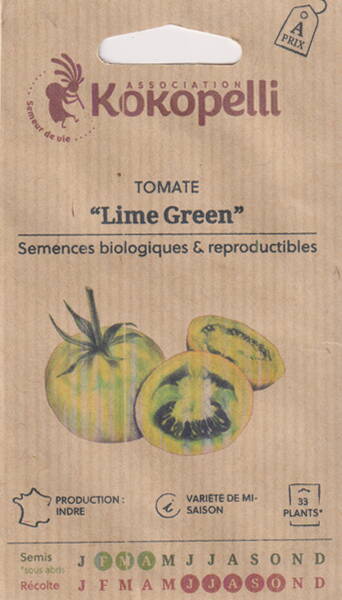
Eco seeds
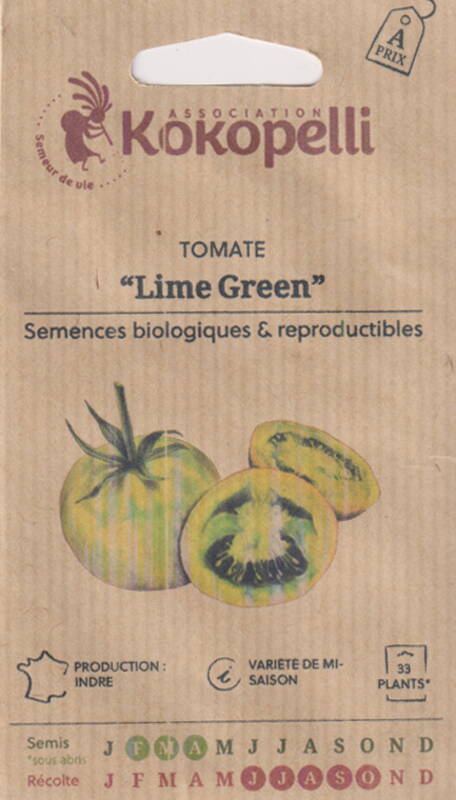
Tomato "Lime Green".
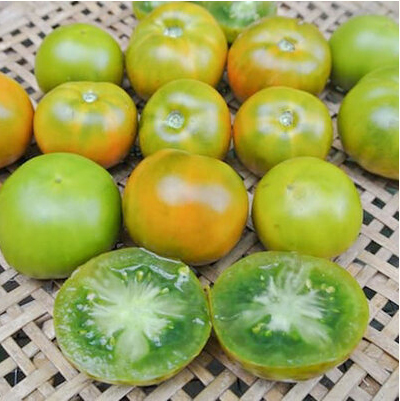
This compact variety, ideal for container growing, produces numerous clusters of 7-9 medium-sized, round, yellow-green fruits weighing 100-150 g. Their dense flesh boasts a delightfully zesty and tangy flavor.
Maturity: Mid-season
Weight: 100-150 g
Shape: Round
Texture: Meaty/Firm
Growth Type: Determinate
Color: Green
Plant Height: 60-90 cm
Fruit Size: 6-8 cm
Foliage: Regular.
This compact variety, ideal for container growing, produces numerous clusters of 7-9 medium-sized, round, yellow-green fruits weighing 100-150 g. Their dense flesh boasts a delightfully zesty and tangy flavor.
Maturity: Mid-season
Weight: 100-150 g
Shape: Round
Texture: Meaty/Firm
Growth Type: Determinate
Color: Green
Plant Height: 60-90 cm
Fruit Size: 6-8 cm
Foliage: Regular.
History: This variety was developed by Tom Wagner of Tater Mater Seeds and introduced by Tim Peters, also known as Peters Seed, in the 1980s. It is also known as "Lime Green Salad" and "Green Elf".
* How to correctly calculate seed sowing dates for high-quality seedlings?
As is well known, crops that lack enough warm days to fully mature in a given climate, or those grown for an earlier harvest, are started as seedlings indoors. For example, many types of cabbage and certain other vegetables have a growing season lasting 150 days or more. Depending on the variety and location, tomatoes begin to ripen 90-160 days after emergence. If tomatoes and sweet peppers are protected from the cold (in a heated greenhouse), they can grow and produce for more than a year.
To calculate the proper seed sowing dates for quality seedlings, you must consider the planting location (open ground or greenhouse, type of greenhouse), the crop's growing season, the time from sowing to germination, and the seed quality (germination energy). For instance, tomato seeds retain normal viability for up to 7 years, and if stored at +14...+16°C with humidity not exceeding 75%, they can last 10 years or more. At temperatures between +22...+25°C, tomato seedlings emerge 4-5 days after sowing. The optimal seedling age for this crop before transplanting to its permanent location is 45-65 days, depending on growing conditions. For sweet peppers and eggplants, this period is 55-60 days; for cucumbers, zucchini, and pattypan squash, it's 20-25 days. However, celeriac seedlings in Estonian conditions are kept indoors for 60-90 days, and its seeds take 12-15 days just to germinate. It is also essential to consider when the soil (in open ground or a greenhouse) will warm up to at least +12...+14°C for heat-loving crops in your specific climate.
Therefore, if you plan to get an early harvest in a heated greenhouse, you can start sowing tomato, sweet pepper, eggplant, and cucumber seeds as early as the beginning of February. However, the seedlings must be provided with sufficient light energy (using grow lights or fluorescent lamps for 12-14 hours a day). When growing in an unheated hoop house, sowing can begin in late February to early March. For growing tomatoes in open ground, if you can protect the plants from possible late frosts in May, 45-60-day-old seedlings can be planted out on May 15-20, or after the threat of frost has completely passed.
Under room conditions, the most acceptable time to sow early cabbage seeds is March 20-25. This allows you to harvest the first heads in open ground by late June or early July. Sowing seeds for late cabbage varieties is done from April 1 to 15.